Book Appointment Now
Custom Lighting Development: From Concept to Mass Production
Follow a custom lighting product from initial concept through prototyping, tooling, sampling, and final mass production at a professional OEM factory.
In today’s competitive lighting industry, standard products are no longer enough to differentiate a brand.
More and more distributors, wholesalers, hospitality designers, and private-label brands are turning to custom lighting development to create unique products that stand out in the market.
As a product development manager working closely with global lighting brands, I’ve helped turn hundreds of ideas—from simple sketches to fully customized LED filament bulbs and decorative lighting products—into mass-produced solutions.
In this article, I will walk you through the complete process of custom lighting development, from the initial concept to final mass production.
Why Custom Lighting Matters Today
Custom lighting is no longer a luxury reserved for high-end brands.
It has become a strategic tool for:
- Brand differentiation
- Higher profit margins
- Exclusive product positioning
- Project-based lighting solutions
- OEM/private label expansion
In hospitality, retail, and architectural projects, designers often require lighting that matches a very specific mood, color temperature, shape, or brand identity.
Standard catalog products simply cannot meet these requirements.
This is where custom manufacturing becomes essential.
Stage 1: Understanding the Concept
Every custom lighting project starts with an idea.
This concept may come in many forms:
- A sketch from a designer
- A reference photo
- A competitor product
- A lighting mood board
- A hotel or restaurant design requirement
At this stage, the goal is not technical perfection but clear communication of intent.
We usually define:
- Product type (bulb, pendant, fixture, etc.)
- Style (vintage, modern, industrial, minimalist)
- Application scenario (hotel, café, retail, residential)
- Target market (EU, US, Middle East, etc.)
The clearer the concept, the faster the development process.
Stage 2: Technical Feasibility Evaluation
Once the concept is clear, the next step is to evaluate whether it can be manufactured.
Our engineering team analyzes:
- Glass structure feasibility
- LED filament arrangement
- Heat dissipation design
- Electrical driver compatibility
- Safety requirements
- Cost implications
Not every idea can be directly produced, especially when it involves:
- Unstable glass shapes
- Extreme miniaturization
- Special dimming requirements
- Unique optical effects
At this stage, we often provide suggestions to optimize the design for production efficiency while preserving the original concept.
Stage 3: Design & Prototyping
After feasibility confirmation, we move to prototype development.
This is where the idea becomes a physical product.
We typically develop:
- 3D design drawings
- Structural diagrams
- LED configuration plans
- Glass mold proposals
Then we produce a sample prototype.
During this stage, key parameters are tested:
- Brightness (lumens)
- Color temperature (Kelvin)
- CRI (Color Rendering Index)
- Power consumption
- Dimming performance
- Heat stability
Prototyping is often an iterative process. Most custom lighting products require 2–3 rounds of refinement before final approval.
Stage 4: Sample Testing and Optimization
Once the prototype is ready, we send samples to the client for evaluation.
Buyers typically test:
- Visual appearance in real environments
- Compatibility with fixtures
- Dimming system performance
- Packaging quality
- Overall design consistency
Feedback is then collected and analyzed.
Common adjustments include:
- Adjusting filament brightness
- Modifying glass color (clear, amber, smoked)
- Improving driver stability
- Refining packaging design
- Optimizing cost structure
This stage ensures the product meets both technical requirements and market expectations.
Stage 5: Tooling and Pre-Production Setup
Once the sample is approved, we move into preparation for mass production.
This includes:
- Glass mold creation
- Production line setup
- Material sourcing
- Quality control planning
- Packaging finalization
Tooling is a critical stage because it determines:
- Production consistency
- Product durability
- Long-term manufacturing cost
- Scalability
For OEM lighting brands, this stage defines the foundation of their product identity.
Stage 6: Mass Production
After tooling is completed, the product enters full-scale production.
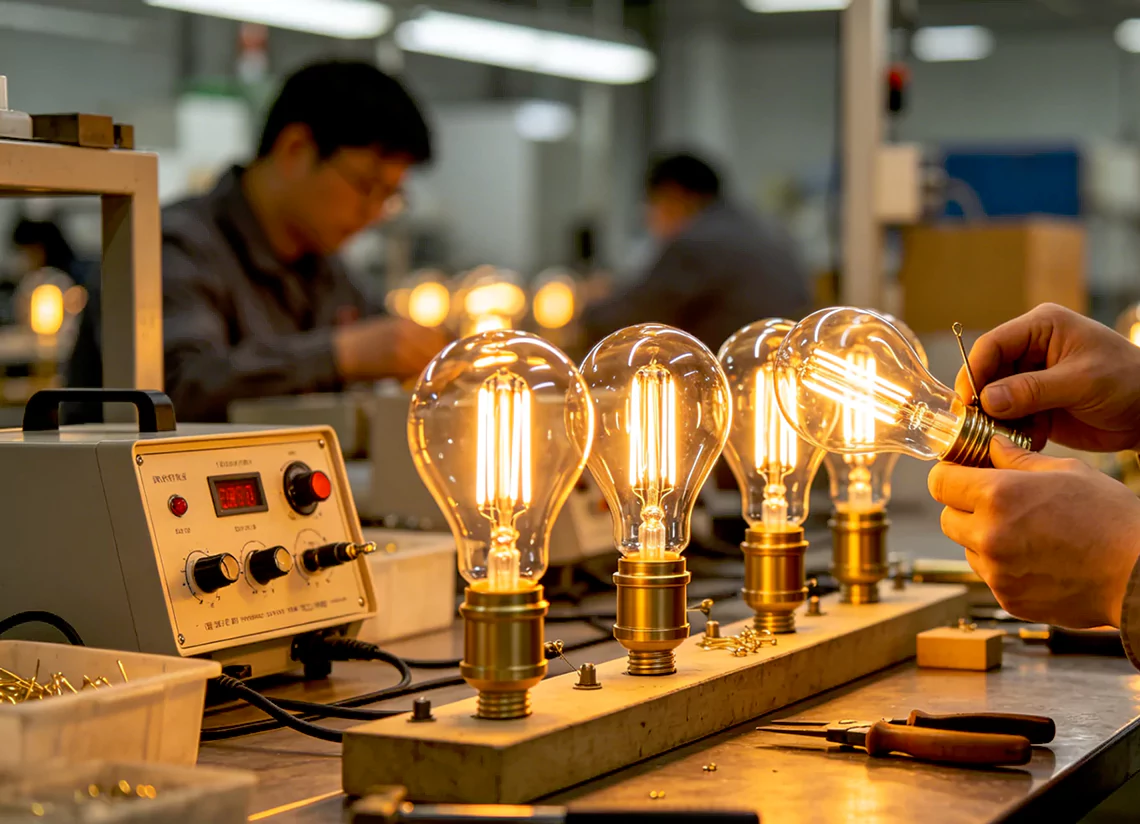
A typical production process includes:
- Raw material inspection
- LED filament assembly
- Glass enclosure production
- Electrical testing
- Aging test (burn-in test)
- Final assembly
- Packaging and labeling
Quality control is applied at multiple stages to ensure stability and consistency.
Key inspection points include:
- Electrical safety
- Brightness uniformity
- Color temperature accuracy
- Flicker performance
- Mechanical durability
At this stage, maintaining strict QC is essential to avoid large-scale quality issues.
Stage 7: Packaging & Branding
For OEM clients, packaging is not just protection—it is part of the brand experience.
We offer:
- Custom color boxes
- Logo printing
- Barcode labels
- Instruction manuals
- Retail-ready packaging
- E-commerce packaging solutions
Well-designed packaging helps brands improve:
- Shelf appeal
- Customer perception
- Retail conversion rates
Many of our clients see packaging as an extension of product design.
Stage 8: Logistics & Global Delivery
Once production is completed, products are prepared for global shipment.
We support:
- Sea freight (FCL/LCL)
- Air freight
- Express delivery for samples
- Multi-warehouse distribution
Proper packaging ensures products remain safe during long-distance transportation.
For international buyers, reliable logistics is just as important as product quality.
Key Challenges in Custom Lighting Development
Custom lighting projects often face challenges such as:
- Miscommunication between design and factory
- Unclear technical requirements
- Overly complex design expectations
- Cost vs performance imbalance
- Certification requirements across markets
Working with an experienced manufacturer helps reduce these risks significantly.
Why Work with an Experienced OEM Lighting Manufacturer
A reliable partner should offer more than production capability.
They should provide:
- Engineering support
- Design optimization
- Material recommendations
- Certification guidance
- Stable mass production capability
- Consistent quality control
- Flexible customization options
This partnership approach is what transforms ideas into successful commercial products.
Final Thoughts
Custom lighting development is a structured process that transforms creative ideas into scalable, market-ready products.
From initial concept and feasibility analysis to prototyping, testing, and mass production, every stage plays a critical role in determining final product success.
For lighting brands, wholesalers, and hospitality project suppliers, working with an experienced OEM manufacturer ensures not only product quality but also faster development cycles and lower business risk.
In today’s competitive global lighting market, the ability to create custom products is one of the most powerful advantages a brand can have.
Looking for a Custom Lighting Development Partner?
We specialize in OEM & ODM decorative lighting solutions for global brands, distributors, and hospitality projects.
Our capabilities include:
- LED Filament Bulb Custom Design
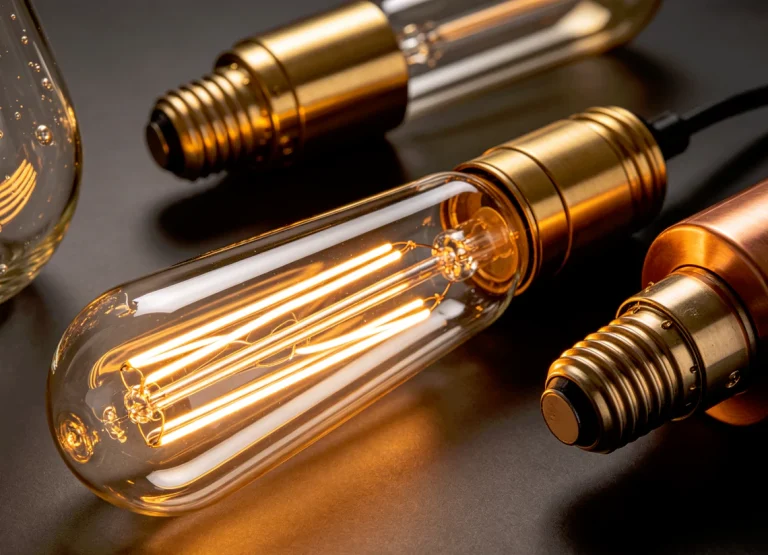
- Vintage Edison Bulb Development
- Globe Bulb Customization (G45 / G80 / G95 / G125)
- Amber Glass & Specialty Finishes
- Dimmable LED Technology Solutions
- Full OEM Branding & Packaging
- Rapid Prototyping & Mass Production
If you have a concept or project idea, our engineering team is ready to help bring it to life—from sketch to finished product.
Contact us today to start your custom lighting development project.